
Harmonics are the foundation of how we read the market. They turn Fibonacci ratios into precise, repeatable reversal patterns — giving us objective zones to plan trades around rather than guesswork.
The origins: H.M. Gartley (1935)
The discipline traces back to Harold McKinley Gartley, who in his 1935 book Profits in the Stock Market described a five-point reversal structure that later became known as the Gartley 222 (after the page it appeared on). It was the first systematic attempt to define a reversal pattern by the proportions between its swings.
Larry Pesavento: adding the Fibonacci ratios
Larry Pesavento built on Gartley’s work in Fibonacci Ratios with Pattern Recognition, mapping specific Fibonacci retracement and extension levels onto the pattern’s points. This gave traders measurable rules for what qualifies as a valid pattern — the bridge between Gartley’s original idea and modern harmonics.
Scott Carney: modern harmonic trading
Scott Carney coined the term harmonic trading and, across Harmonic Trading Volume 1 & 2, defined and named the pattern family used today — the Bat, Crab, Shark and Cypher among them — each with strict ratio requirements and a defined potential reversal zone.
How we apply harmonics
We use harmonics alongside classic and directional patterns across all timeframes. A harmonic pattern gives us a ratio-defined reversal zone; classic structure and directional tools then confirm whether momentum supports the trade. This layering is what lets us isolate high-probability setups. Many of these are walked through on live Gold, FX and crypto charts in our Videos section.
Watch it in action: Butterfly + AB=CD on the H4
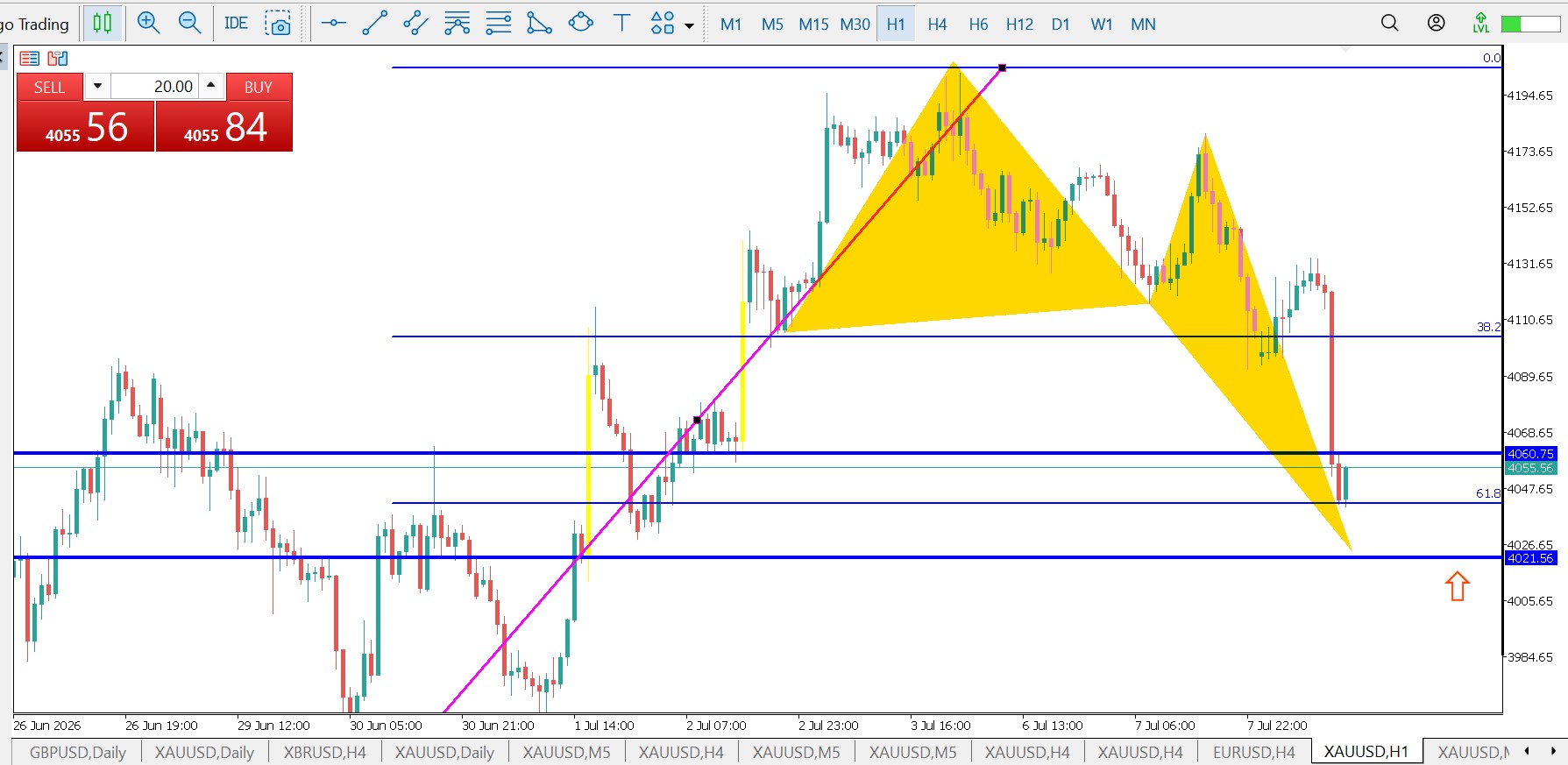
Here is a live example of a Butterfly pattern combined with an AB=CD completion on the 4-hour chart — exactly the kind of ratio-defined setup described above.
Frequently asked questions
What is harmonic trading?
Harmonic trading identifies precise, Fibonacci-defined price patterns that tend to mark reversal zones. It grew out of H.M. Gartley’s pattern work in the 1930s, was extended with Fibonacci ratios by Larry Pesavento, and was formalised into named patterns by Scott Carney.
Who invented harmonic patterns?
H.M. Gartley described the original five-point 222 pattern in his 1935 book Profits in the Stock Market. Larry Pesavento later mapped specific Fibonacci ratios onto it, and Scott Carney defined and named the modern harmonic patterns such as the Bat, Crab, Shark and Cypher.
What are the main harmonic patterns?
The most widely used are the Gartley, Butterfly, Bat, Crab, Shark and Cypher. Each is defined by specific Fibonacci retracement and extension ratios between its swing points, which is what separates a valid harmonic pattern from a generic zig-zag.
How does Harmonics Pro Trader use harmonic patterns?
We combine harmonics with classic and directional patterns across all timeframes. Harmonics give us ratio-defined reversal zones; the other tools confirm structure and momentum. Most of these setups are demonstrated live in our Videos section.
Educational content only. Nothing here is financial advice. Book and pattern attributions reference the authors’ published works.